
Foamed PVC board feels lightweight and easy to handle—ideal for signage, interior cladding, and fabrication—but does its low weight compromise structural integrity under load? As a trusted manufacturer of high-performance plastic sheets since 2008, Jinan Huayu International Trade Co., Ltd. helps global buyers evaluate real-world performance across hard PVC board, foamed PVC board, PVC wall panels, acrylic sheet, and HDPE board. Whether you’re an engineer assessing load capacity, a project manager specifying materials, or a distributor verifying compliance, this article cuts through the myths to deliver data-driven insights on strength-to-weight ratios, deflection limits, and application-specific suitability.
What Foamed PVC Board Actually Delivers Under Load
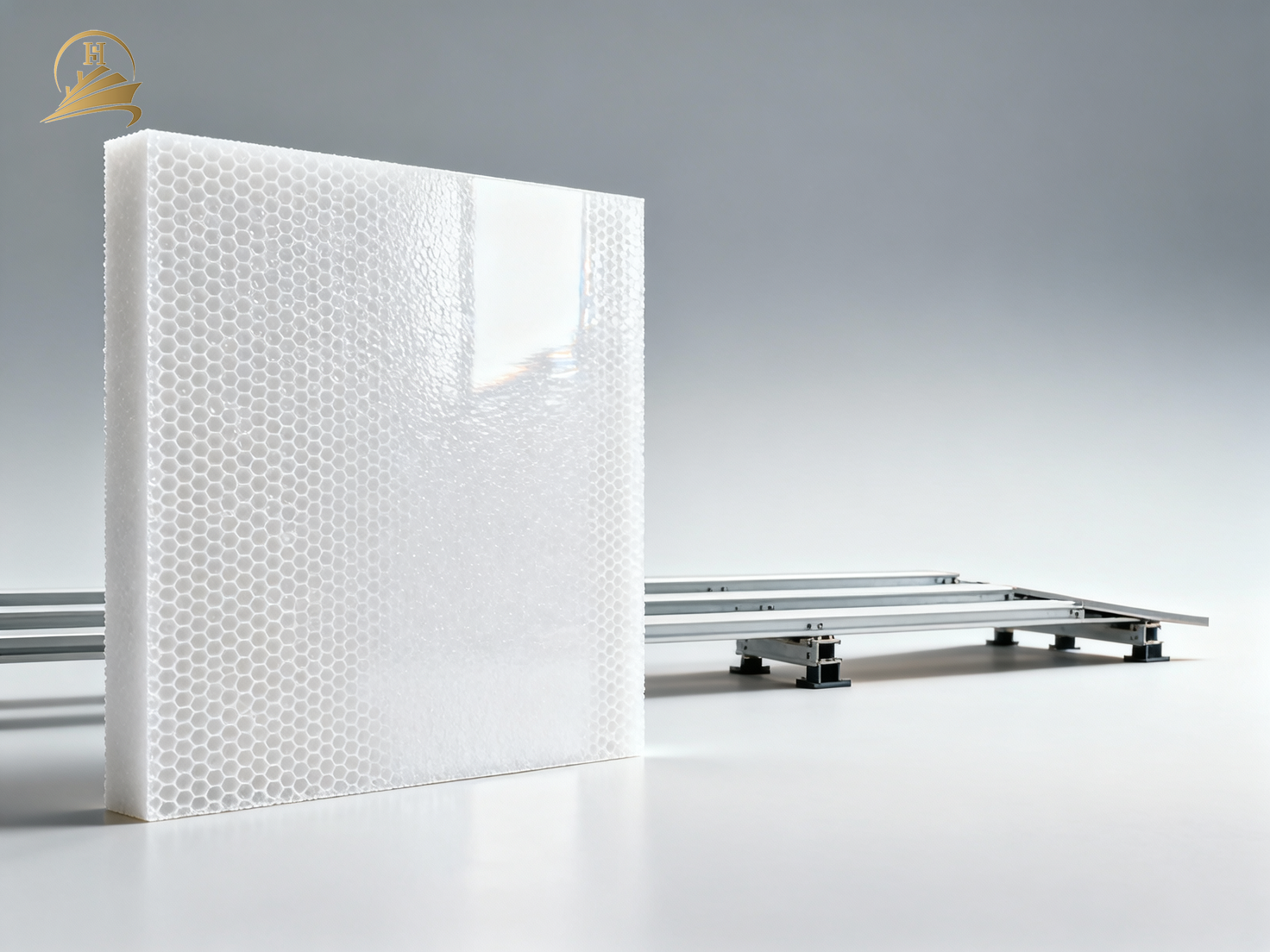
Foamed PVC board is not solid plastic—it’s a closed-cell cellular structure with density typically ranging from 0.4–0.7 g/cm³. This microstructure enables significant weight reduction (up to 60% lighter than solid PVC) while retaining dimensional stability and machinability.
Structural performance depends on core density, skin thickness, and manufacturing consistency. At Jinan Huayu, our foamed PVC boards undergo three-point bending tests per ISO 178, delivering flexural strength values between 18–32 MPa and modulus of elasticity from 1,200–2,600 MPa—values validated across 3 mm to 25 mm thicknesses.
Critical to real-world use: deflection under uniform load. A 6 mm board supported at 600 mm spans deflects ≤1.8 mm at 1.5 kPa—a safe threshold for non-load-bearing partitions and signage frames. For heavier-duty applications, we recommend ≥12 mm thickness with reinforced edge mounting.
How It Compares to Alternatives in Key Structural Metrics
Choosing the right sheet isn’t about “lightest” or “strongest”—it’s about matching material behavior to functional requirements. Below is a direct comparison of mechanical properties relevant to structural evaluation:
This table confirms a key insight: foamed PVC delivers the best strength-to-weight ratio among common plastic sheet options—making it ideal where handling efficiency, transport cost, and installation speed matter without sacrificing rigidity.
Where Foamed PVC Meets—and Where It Exceeds—Structural Expectations
Foamed PVC is structurally appropriate for defined use cases—not universal substitution. Its optimal applications include:
- Interior wall cladding systems with ≤1,200 mm stud spacing (tested per EN 13964 for non-load-bearing assemblies)
- Digital signage substrates up to 1.2 m × 2.4 m, mounted using perimeter framing or Z-clips
- Architectural formwork for curved soffits and lightweight façade elements (max continuous service temp: 60°C)
- Machine guards and protective covers requiring impact resistance and chemical resistance (per ISO 6603-2 Izod impact: 25–35 kJ/m²)
It is not recommended for primary structural beams, floor decking, or outdoor canopies subject to sustained wind uplift >1.2 kPa without engineered reinforcement.
Procurement Checklist: 5 Non-Negotiables for Structural Confidence
When sourcing foamed PVC for applications involving load considerations, verify these five criteria before placing order:
- Batch-tested mechanical data sheets (not generic brochures), including flexural strength, modulus, and density measured per ASTM D790 or ISO 178
- Consistent skin thickness (±0.15 mm tolerance) verified via ultrasonic measurement across full sheet area
- ISO 9001-certified production process with traceable lot numbers and QC records available upon request
- Standard delivery lead time: 7–12 working days for standard sizes (1,220 × 2,440 mm); custom thicknesses add 3–5 days
- Free sample support—including cut test pieces for your own load simulation—available within 48 hours of inquiry
Why Global Buyers Specify Jinan Huayu for Structural-Grade Foamed PVC
Since 2008, Jinan Huayu has supplied over 120 countries with foamed PVC boards engineered for predictable performance—not just lightness. Our factory controls every stage: raw material selection (virgin PVC resin only), extrusion temperature profiling (±2°C precision), and post-extrusion annealing to minimize internal stress.
We support technical decision-makers with: certified test reports, CAD-compatible technical drawings, mounting guidance documents, and rapid-response engineering consultation—typically within 2 business hours.
Contact us today to request: (1) application-specific deflection calculations, (2) comparative samples vs. your current material, or (3) compliance documentation for CE, RoHS, or UL recognition pathways.
Related Posts
- India delays BIS PVC import certification deadline to December 24, 2026Aug 17, 2026India delays BIS PVC import certification deadline to December 24, 2026. See how PVC sheets and profiles exporters can use the extra time to prepare compliance and avoid trade disruption.
- Brazil Extends Anti-Dumping Duty on Chinese PVC Resin for Five More YearsAug 17, 2026PVC resin anti-dumping duty in Brazil is extended to 2031, reshaping PVC board sourcing, compliance, and delivery strategy. Discover the key procurement risks and supplier shifts.
- China PVC Sheet Output Rises, Lead Times ShortenAug 14, 2026China PVC sheet output rises as lead times drop to 10-12 days, signaling faster delivery and stronger supply response for global buyers.
Get A Quote

First class quality service and professional after-sales team.
Get A Quote
*We respect your confidentiality and all information are protected.