
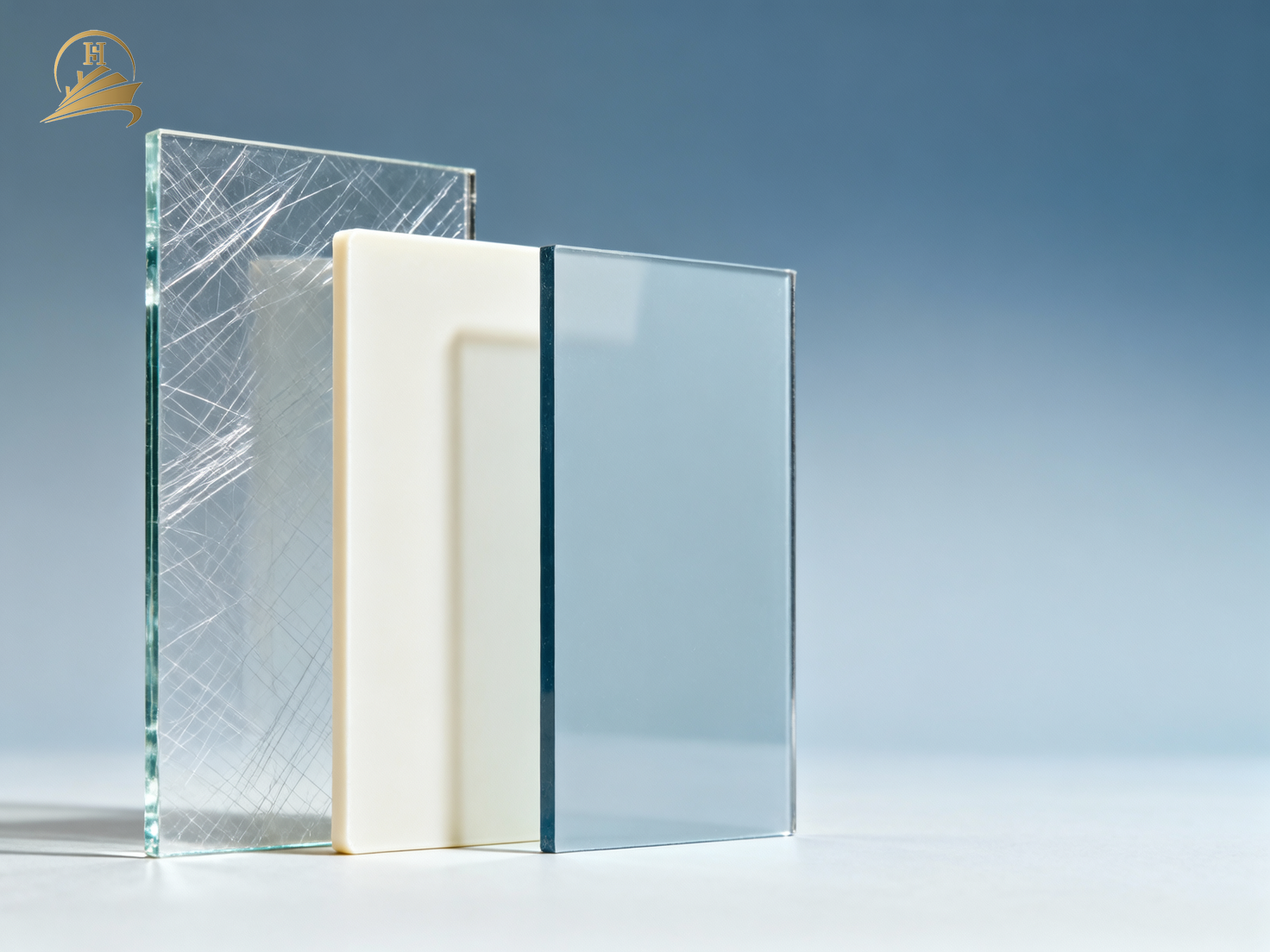
Acrylic sheet scratches more easily than HDPE—but is that always a drawback? When comparing acrylic board, rigid PVC board, foamed PVC board, PVC wall panel, and HDPE board, surface durability is just one factor among many—optical clarity, chemical resistance, thermal stability, and machinability matter equally. For information seekers, engineers, quality controllers, and procurement decision-makers, understanding contextual trade-offs is key. At Jinan Huayu International Trade Co., Ltd.—a China-based manufacturer of high-performance plastic sheets since 2008—our technical team helps global clients select the optimal material based on real-world application demands, not just scratch resistance alone.
Why Scratch Resistance Alone Misleads Material Selection
Scratch resistance is often overemphasized in early-stage evaluations—especially when sourcing plastic sheets for industrial or architectural use. Acrylic (PMMA) typically scores 3–4 on the Mohs hardness scale, while HDPE registers ~2.3. Yet this difference doesn’t automatically make HDPE “superior”: acrylic retains >92% light transmission, whereas HDPE is opaque and UV-stabilized only for outdoor exposure.
In applications requiring optical precision—backlit signage, medical device housings, or laboratory viewing windows—acrylic’s susceptibility to fine abrasion is outweighed by its dimensional stability (±0.05 mm tolerance at 20℃) and low moisture absorption (<0.3%). HDPE’s flexibility and impact strength shine in rugged environments like pallets, chemical tanks, or marine components—but it cannot replace acrylic where clarity or laser-cut edge finish matters.
Our R&D team at Jinan Huayu validates every sheet batch against ISO 9001-compliant testing protocols—including ASTM D1044 for abrasion resistance, ASTM D792 for density, and UL 94 HB for flame propagation. Real-world performance—not lab-only metrics—guides our recommendations.
Comparing Key Performance Dimensions Across Five Core Materials
Selecting the right plastic sheet involves balancing six interdependent criteria: surface hardness, optical clarity, thermal deflection temperature (HDT), chemical resistance, machinability, and long-term UV stability. Below is how acrylic, rigid PVC, foamed PVC, PVC wall panel, and HDPE compare across standardized test conditions:
This table reflects typical values under standard atmospheric conditions (23℃, 50% RH). Foamed PVC and PVC wall panels prioritize rigidity-to-weight ratio and fire-retardant additives—making them ideal for interior cladding with 3–5 year warranty cycles. Acrylic remains unmatched for applications demanding optical fidelity over 10+ years of indoor service life.
When Is Lower Scratch Resistance Actually an Advantage?
Counterintuitively, acrylic’s relative softness enables superior post-processing outcomes. Its low glass transition temperature (~105℃) allows thermoforming without cracking—even complex 3D bends with radii as tight as 3× material thickness. HDPE requires higher heat input and longer cooling cycles, increasing warpage risk beyond ±0.8 mm per meter.
Additionally, acrylic accepts solvent bonding (e.g., dichloromethane) for seamless joints—critical in cleanroom partitions or aquarium construction. HDPE must be welded or mechanically fastened, introducing potential leak paths or stress concentrations.
At Jinan Huayu, we offer anti-scratch coated acrylic variants (e.g., MR-ACR series) that retain 88% light transmission while improving pencil hardness to 4H—tested per ASTM D3363. These are routinely specified for touch-panel overlays and retail display fixtures requiring both clarity and daily abrasion resilience.
How Jinan Huayu Supports Your Technical & Procurement Workflow
As a manufacturer operating since 2008, we deliver end-to-end support across four phases: specification alignment (within 48 hours), sample dispatch (3–5 business days), production scheduling (lead time: 7–15 days for standard grades), and documentation handover (including RoHS/REACH compliance reports).
We maintain inventory of 12 acrylic thicknesses (1.5–25 mm), 8 HDPE densities (0.93–0.97 g/cm³), and custom-cut rigid PVC up to 3050 × 1525 mm—enabling JIT delivery for distributors and OEMs managing multi-site projects.
For technical evaluators and project managers: request our free Material Selection Matrix, which maps 27 common use cases (e.g., food-grade conveyor guards, LED diffuser panels, chemical fume hood liners) to optimal polymer grades, surface treatments, and certification pathways—including FDA 21 CFR 177.1010 for food contact and EN 13501-1 for fire classification.
Contact us today for:
- Real-time stock availability for acrylic, HDPE, rigid PVC, foamed PVC, and PVC wall panel
- Custom thickness, color, or UV-stabilization options (minimum order: 500 kg)
- Technical data sheets with third-party test reports (ASTM/ISO/UL)
- Sample kits with comparative scratch-abrasion demonstration tools
Related Posts
- India delays BIS PVC import certification deadline to December 24, 2026Aug 17, 2026India delays BIS PVC import certification deadline to December 24, 2026. See how PVC sheets and profiles exporters can use the extra time to prepare compliance and avoid trade disruption.
- Brazil Extends Anti-Dumping Duty on Chinese PVC Resin for Five More YearsAug 17, 2026PVC resin anti-dumping duty in Brazil is extended to 2031, reshaping PVC board sourcing, compliance, and delivery strategy. Discover the key procurement risks and supplier shifts.
- China PVC Sheet Output Rises, Lead Times ShortenAug 14, 2026China PVC sheet output rises as lead times drop to 10-12 days, signaling faster delivery and stronger supply response for global buyers.
Get A Quote

First class quality service and professional after-sales team.
Get A Quote
*We respect your confidentiality and all information are protected.