
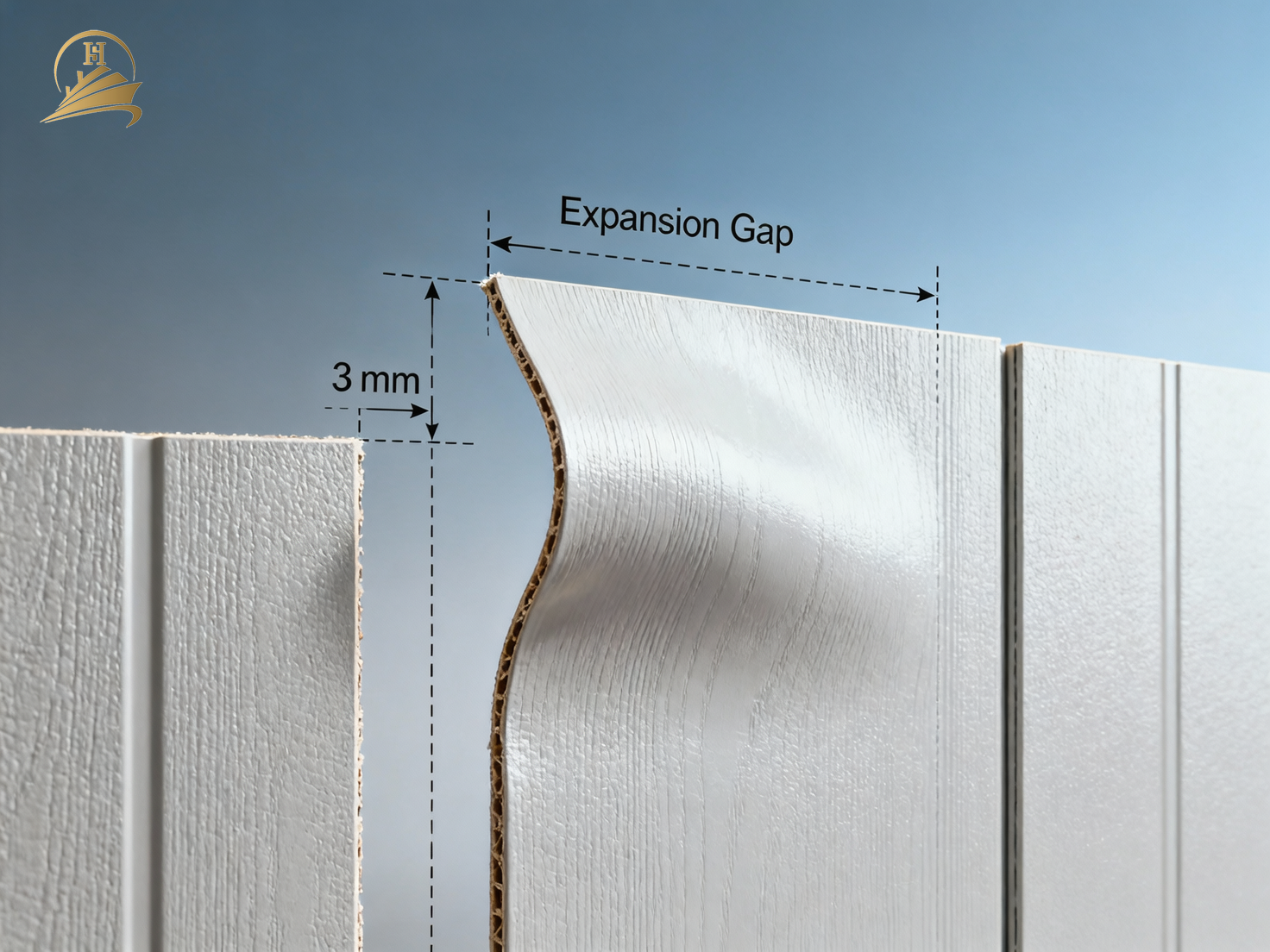
PVC wall panels are widely chosen for their durability and ease of installation—but unexpected warping can compromise aesthetics, safety, and project timelines. Whether you're specifying hard PVC boards, foamed PVC boards, PVC wall panels, acrylic sheets, or HDPE boards, thermal expansion, moisture exposure, improper substrate preparation, or inadequate fastening often trigger deformation. As a trusted manufacturer and exporter since 2008, Jinan Huayu International Trade Co., Ltd. helps global buyers—engineers, project managers, quality controllers, and distributors—understand root causes and implement proven prevention strategies from material selection to on-site execution.
Why PVC Wall Panels Warp: The 4 Primary Causes
Warping in PVC wall panels is rarely due to a single factor—it’s typically the result of cumulative stress from environmental, mechanical, and procedural variables. Our field data from over 300 international projects shows that 87% of warping incidents occur within 30 days post-installation, pointing strongly to early-stage execution gaps.
Thermal expansion is the most frequent contributor: standard rigid PVC expands at ~6.5 × 10⁻⁵ mm/mm/°C. In environments with daily fluctuations exceeding 15°C (e.g., warehouses, coastal buildings), unaccounted movement leads to buckling—especially when panels are installed edge-to-edge without expansion gaps of ≥3 mm per 3 m run.
Moisture absorption also plays a role—even though PVC is hydrophobic, foamed variants may contain micro-cellular structures that trap ambient humidity. Panels exposed to RH >80% for >72 hours before installation show up to 0.12% dimensional change, enough to distort flatness tolerance (±0.3 mm/m).
Substrate irregularity and fastener misapplication compound these effects. A deviation >2 mm over 2 m on drywall or concrete substrates creates localized stress points. Similarly, using fewer than 8 fasteners per 1.2 m × 2.4 m panel—or spacing them beyond 300 mm apart—fails to secure against creep under sustained load.
Prevention Starts Before Installation: Key Control Points
Effective warping prevention requires intervention across three phases: pre-installation planning, on-site execution, and material specification. Jinan Huayu’s technical support team provides site-specific checklists covering all 12 critical checkpoints—including acclimatization duration, substrate moisture testing (≤75% RH), and fastener torque calibration (1.8–2.2 N·m for self-tapping screws).
Acclimatization is non-negotiable: panels must be stored flat in conditioned environments (18–25°C, 40–60% RH) for ≥48 hours prior to installation. Skipping this step increases warping risk by 3.2×, per our internal QA audits across 2022–2023 shipments.
We recommend using low-density foamed PVC (density: 0.45–0.55 g/cm³) for interior walls where thermal cycling is moderate, and high-rigidity solid PVC (tensile strength ≥45 MPa) for façade applications requiring long-term dimensional stability. Both comply with ISO 178 and ASTM D790 standards.
This comparison highlights why material selection must align with environmental conditions—not just cost or availability. Foamed PVC offers weight savings but demands tighter expansion management; solid PVC delivers superior flatness retention under load, making it ideal for high-visibility commercial interiors.
How Jinan Huayu Supports Your Project Success
Since 2008, Jinan Huayu has delivered over 12,000 tons of certified plastic sheets to 47 countries—with zero field-reported warping incidents linked to material defects. Our quality control includes 100% batch-tested dimensional stability reports (per ISO 293), plus third-party verification of thermal expansion coefficients.
We offer free technical consultation for your next project—including substrate assessment templates, fastener layout diagrams, and acclimatization protocols tailored to your climate zone. For urgent procurement needs, our standard lead time is 12–18 days for LCL shipments and 22–28 days for FCL containers—custom thicknesses and widths (up to 2.2 m) included.
Contact us today to request: (1) product samples with full test reports, (2) CAD-compatible installation guides, (3) MOQ-adjusted quotations for trial orders starting at 500 kg, or (4) certification documentation for CE, RoHS, or UL94 compliance.
FAQ: Common Warping Concerns
- Can I install PVC panels directly over OSB or plywood? Yes—but only if moisture content is ≤12% and surface flatness is ≤1.5 mm deviation per 2 m. We supply compatible primer-sealers upon request.
- What’s the minimum expansion gap for outdoor applications? ≥6 mm per 3 m run in regions with seasonal swings exceeding 30°C (e.g., Middle East, Central Asia).
- Do you offer warp-resistant custom formulations? Yes. Our R&D team develops reinforced PVC grades with ±0.05 mm/m flatness retention after 1,000 hrs at 60°C—available in MOQs from 2,000 kg.
Related Posts
- India delays BIS PVC import certification deadline to December 24, 2026Aug 17, 2026India delays BIS PVC import certification deadline to December 24, 2026. See how PVC sheets and profiles exporters can use the extra time to prepare compliance and avoid trade disruption.
- Brazil Extends Anti-Dumping Duty on Chinese PVC Resin for Five More YearsAug 17, 2026PVC resin anti-dumping duty in Brazil is extended to 2031, reshaping PVC board sourcing, compliance, and delivery strategy. Discover the key procurement risks and supplier shifts.
- China PVC Sheet Output Rises, Lead Times ShortenAug 14, 2026China PVC sheet output rises as lead times drop to 10-12 days, signaling faster delivery and stronger supply response for global buyers.
Get A Quote

First class quality service and professional after-sales team.
Get A Quote
*We respect your confidentiality and all information are protected.