
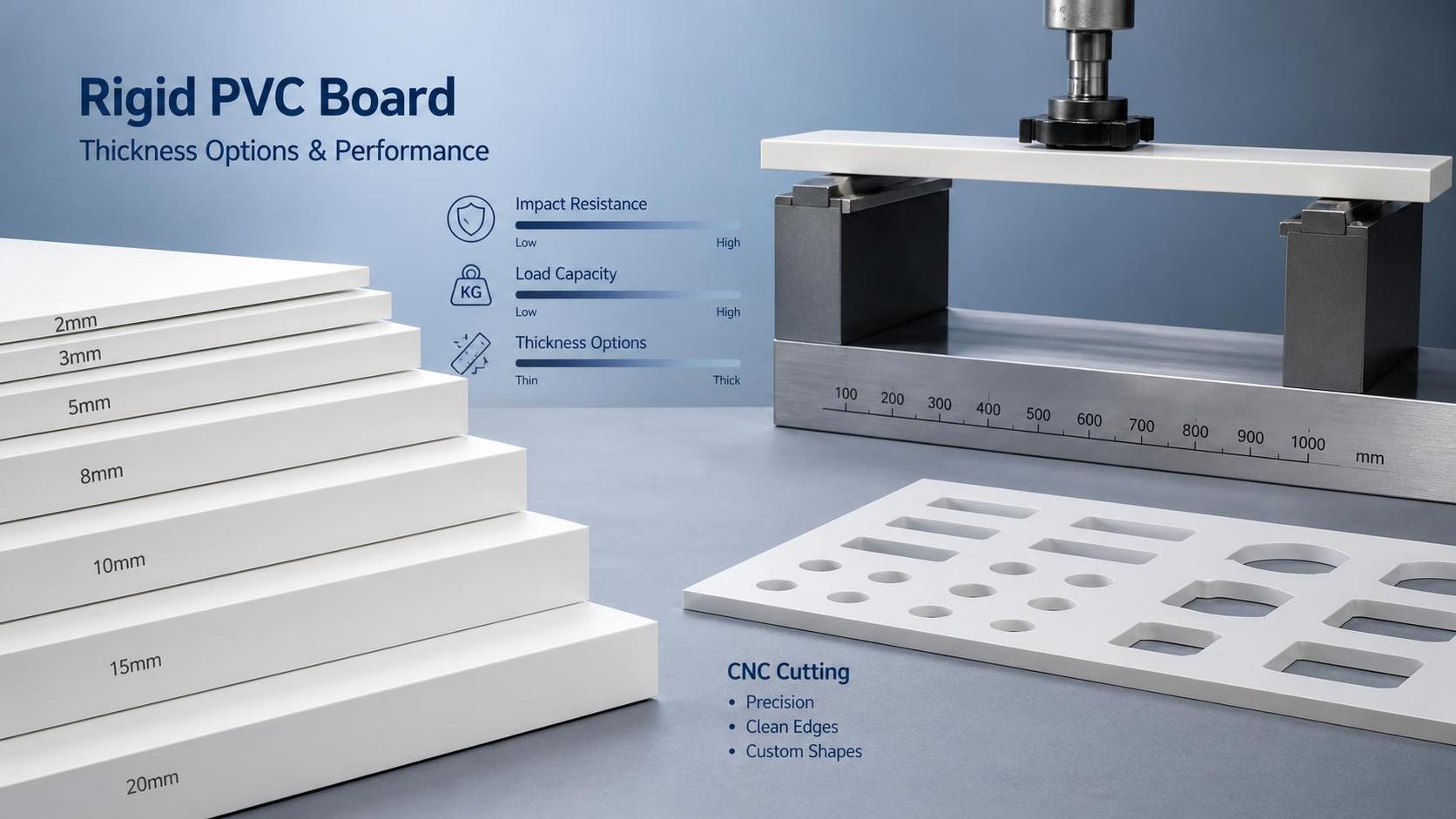
How to Choose Rigid PVC Sheet Thickness for Impact and Load Needs
Choosing the right Rigid PVC Sheet thickness usually becomes urgent when a panel starts feeling too flexible on the drawing, or when a buyer realizes that impact resistance and load support are being treated as the same thing. In real projects, that confusion can lead to cracked guards, warped covers, difficult machining, or unnecessary material cost.
If you are comparing thickness options for protective panels, fabricated machine parts, equipment covers, partitions, or load-bearing surfaces, the practical question is not simply “thicker is better.” The better question is how much impact the sheet must absorb, how it will be supported, what kind of load it will carry, and whether the part still needs to be cut, drilled, or machined efficiently. That is where Rigid PVC Sheet selection becomes a decision process rather than a guess.
Why thickness selection causes problems so often
Many people start with application labels instead of working conditions. A panel may be described as a guard, a cover, a backing board, or a structural insert, but those names do not tell you enough. A machine guard may only need light impact resistance if it is fully framed. A similar-looking cover may need much greater stiffness if it spans an unsupported opening. When those differences are missed, the chosen thickness often fails in the real installation even though it looked acceptable on paper.
Another common issue is mixing up short-term impact with long-term load. Impact asks how the sheet responds to sudden force, such as accidental contact, dropped tools, or handling during installation. Load asks how the sheet behaves under steady pressure, mounted weight, or repeated bending over time. A sheet that survives occasional knocks may still sag if it is too thin for the span. A thicker sheet may solve that, but it can also add cost, increase weight, and make machining less efficient than necessary.
Start with the actual job the Rigid PVC Sheet has to do
The most reliable way to choose thickness is to define the sheet’s role in plain terms before comparing sizes. Ask whether the sheet is acting mainly as a barrier, a surface, a liner, a fabricated component, or a semi-structural panel. Then check how it is mounted: fully supported, edge-supported, point-fixed, or partly cantilevered. These details matter more than a broad description like “industrial use” or “protective application.”
A useful screening method is to sort the project into three operating priorities. First, does impact matter most because the sheet may be struck, bumped, or handled roughly? Second, does stiffness matter most because the sheet must stay flat across a span? Third, does fabrication matter most because the sheet will be turned, milled, drilled, or assembled into a more complex part? In many projects all three matter, but one of them usually drives the minimum thickness.
Common thickness decision mistakes to avoid
The first mistake is selecting by feel alone. A sample in hand may feel strong, but once it is installed across a wider unsupported area, its behavior changes. The second mistake is copying a thickness from another project without checking support conditions. Two panels made from the same material can need different thicknesses simply because one is fully backed and the other is free-spanning.
The third mistake is overlooking secondary operations. If the sheet will be drilled near the edge, machined into slots, or fitted around hardware, the remaining section may become weaker than expected. In that situation, the nominal thickness is only part of the picture. The final geometry after processing is what determines how the part performs.
The fourth mistake is choosing the maximum thickness too early. Extra thickness can improve rigidity, but it may also create unnecessary weight, raise cutting time, and complicate assembly tolerances. For buyers managing repeat orders or multi-part fabrication, overbuilding every part can become an avoidable cost issue.
How to compare thickness options by impact and load need
A practical decision process starts by separating light, moderate, and demanding service conditions. For light-duty covers or liners with strong backing support, thinner Rigid PVC Sheet options may be enough because the support structure is doing most of the work. For moderate-duty panels that may face routine contact or limited spans, a middle thickness often gives a better balance between stiffness and machinability. For more demanding uses, such as free-spanning panels, repeated handling, or parts with cutouts and fastener points, thicker material is usually easier to justify.
Impact-heavy applications should be judged by likely contact conditions rather than worst-case imagination. Ask what may actually hit the surface, how often, and whether the impact is concentrated at one point or spread across an area. A protective shield near foot traffic, rolling carts, or manual tools will usually need more thickness margin than a decorative infill panel in the same facility.
Load-heavy applications should be judged by span, support spacing, and direction of force. Even a durable sheet can deflect too much if it bridges a wide opening with little support. When load is the main concern, reducing unsupported distance is often just as effective as increasing thickness. In many cases, adding support ribs or changing the frame layout improves performance more efficiently than moving straight to a heavier sheet.
A simple selection path that works in real purchasing discussions
- Define the installation layout. Confirm whether the sheet is fully backed, edge-supported, or spanning open space. Thickness decisions made without this are usually unreliable.
- List the main stresses. Separate sudden impact, steady load, vibration, and handling damage. The main stress should guide the first thickness shortlist.
- Check fabrication details. Review drilled holes, routed slots, corners, cutouts, and edge distance. Machined features can reduce effective strength in the finished part.
- Review service environment. Consider whether the sheet is used indoors, around chemicals, in wash-down areas, or near heat sources, because those factors can change how conservative the thickness choice should be.
- Balance material and support design together. If a panel seems to require excessive thickness, recheck whether better support spacing or frame design could solve the problem more efficiently.
- Confirm supply and processing capability. If the sheet must be custom-cut or machined into a finished component, make sure the supplier can process the chosen thickness accurately and consistently.
When custom machining changes the better thickness choice
Thickness selection is not only a material question; it is also a fabrication question. A part that looks simple as a flat board may become more sensitive once turning, milling, or drilling is involved. Holes near the edge, narrow ribs, countersinks, and routed windows all reduce local strength. In that situation, a buyer may choose a slightly thicker Rigid PVC Sheet not because the full panel needs it everywhere, but because the machined areas need more margin.
This is where working with a manufacturer that can supply both sheet material and deep processing is useful. If a project includes custom dimensions, drilled patterns, or CNC-machined shapes, thickness can be reviewed together with the drawing instead of being decided in isolation. That usually leads to a more realistic balance between strength, processing efficiency, and finished-part stability.
Do not ignore adjacent material choices during evaluation
In some buying cycles, teams compare rigid PVC with other plastic sheets at the same time because the project includes more than one panel function. For example, a system may use rigid PVC for chemically resistant fabricated parts while using acrylic for optical or appearance-driven sections. In those mixed-material discussions, it helps to keep thickness logic tied to function, not habit. A product such as Black Cast Acrylic Sheet | 1220x2440mm PMMA Wholesale Supplier may be relevant for adjacent visual or shielding elements, but it should not replace proper Rigid PVC Sheet thickness evaluation where impact tolerance, load behavior, and fabrication requirements are the main concern.
What experienced buyers usually verify before placing the order
Before final confirmation, experienced buyers usually go back to a short checklist. They verify the unsupported span, the mounting method, whether fasteners create stress points, whether the sheet will carry its own weight vertically or horizontally, and whether the part includes machined reductions in section. They also check whether the selected thickness still makes sense after packaging, shipping, installation handling, and long-term service are considered together.
For projects with varied panel sizes, it is often better to define thickness by application group rather than force every part into a single specification. That keeps the purchase organized while avoiding needless overbuilding. A supplier with broad plastic sheet manufacturing and processing capability can usually help align stock material, custom cutting, and machined output so the selected thickness works in production as well as in theory.
Frequently Asked Questions
Is thicker Rigid PVC Sheet always better for impact resistance?
No. Greater thickness often improves toughness in practical use, but impact performance also depends on support conditions, part geometry, and where the force is applied. A well-supported panel can outperform a thicker but poorly supported one.
How do I choose between solving the problem with more thickness or more support?
If deflection across a span is the main issue, adding support or reducing unsupported distance may be the more efficient fix. If the part also includes cutouts, edge drilling, or repeated handling, increasing thickness may still be necessary.
Does machining affect thickness choice?
Yes. Drilling, milling, slotting, and edge details can weaken local areas of the sheet. That is why thickness should be reviewed alongside the final part drawing, not only the raw sheet size.
Should I use one thickness for every panel in the same project?
Not always. If the panels do different jobs, one standard thickness can be inefficient. Grouping thickness by function is usually a better purchasing and engineering approach.
Final takeaway
The right Rigid PVC Sheet thickness comes from matching the sheet to real impact conditions, actual load paths, support spacing, and fabrication details. When a panel choice feels uncertain, the most useful move is to stop asking for a universal thickness and start defining the job more precisely. That usually makes the decision clearer, reduces avoidable cost, and leads to a sheet that performs the way the finished part actually needs it to.
For buyers sourcing from a manufacturer with solid rigid PVC sheets, foam boards, acrylic, HDPE, UHMWPE, and CNC processing capability, thickness selection can be reviewed together with cutting and machining requirements early in the process. That keeps the decision practical and avoids discovering fit or performance issues after the material is already ordered.
